We have all faked it at some point – Shabi?

Let’s be honest. We have all padded reality a little, and we started quite early.
First it was powder on the face, then a moisturising lotion; before we knew it we started adding much longer hair, nails, eyelashes, thicker muscles and padding here and there – just a little touch-up, and boom your mom can’t recognise you anymore! Oya, jokes apart, man or woman, young or old, we have all done micro versions of reality-bending; we all accept it. Nobody calls you a fraud for wearing makeup or perfume.
Why do we accept it? The person is still there. The enhancement sits on top of a real human. We can still separate you from the powder or filler (arguably). There is still a real you underneath somewhere sha, and that’s what we recognise and trust.
But this floor has shifted under our feet, ọ́pọ́n ti sùn (things have changed).
For centuries we lived by a simple rule: seeing is believing. If you saw it, it happened. If you heard a voice, someone said or sang it. Our whole society, our money, our courts, our news, our relationships, was built on the shared foundation of trust. I do not think we can say seeing is believing anymore.
I call this the Illusion of Reality: the false belief that what we see, hear, and receive digitally maps to what is actually happening. It no longer always does. And unlike makeup, the person no longer has to be there; the face, voice, words, all of it can now be generated or cloned (almost) perfectly by artificial intelligence. Most people have no idea.
The question is: how did we get here, what does it affect, and how can we navigate this illusion?
The crisis of knowing: how we got here
There is a collapse in our ability to verify reality with our own senses. To understand it, we have to go back, because deception is not new. What is new, is the engine behind it. But nothing prepared us for what came next.
In 2014, a researcher named Ian Goodfellow introduced the Generative Adversarial Network (GAN). The idea is beautiful, but a little frightening. You set two AIs against each other. One creates a fake image while the other tries to catch it. The first takes that feedback, corrects itself, and tries again, back and forth, several rounds, until the fake becomes so good the detector can no longer tell.
Think about that. The system is designed to perfect its own lie, by itself. That is the framework underneath all of this. It is designed to keep improving – by itself!.
For a while, GANs laid low in labs. Then in 2017, it japa-ed (escaped). A Reddit user with the handle deepfakes started swapping celebrity faces onto other bodies, and the name stuck. By January 2018, an app called FakeApp put face-swapping in the hands of anyone with a laptop. By 2019, the firm Deeptrace counted 14,678 deepfake videos online, nearly double the year before, and 96% of them were non-consensual pornography.

Fast forward to 2026. We have crossed what researchers call the indistinguishable threshold, the point where humans can no longer reliably tell real from fake across voice, video and image. In a 2025 report of 2,000 people by the biometric firm iProov, only 0.1% could correctly tell real from fake (iProov, 2025). Not 10%. Not 1%. Meaning 2 out of 2,000 people péré (only) could distinguish fake from real photos 10 of 10 – you can try here.
From deep fake to wide fake
Here is a framing I want you to take away, because it explains everything that follows.
When this all started, it was a deepfake, with the emphasis on depth. You need real technical skill. You needed to know how to do serious computer gymnastics, expensive computing power, almost nobody could just wake up to be deepfaking, you can understand why only a skilled few could make anything convincing; bottom line, the barrier was high.
That barrier is gone. We have moved from deep fake to what I call wide fake, where almost anybody can do it. Three things made the jump possible.
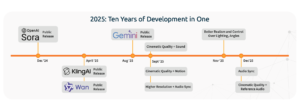
- Better technology: The fakes are more believable than ever and getting better. Today, we have a whole decade of progress happening within ten months!
- Faster and freer generation: You can now churn out convincing fakes in seconds, often for free, on a smartphone already in your pocket, because the business model rewards making it cheap and easy.
- Frictionless distribution: Social media, where one fake can reach millions before you finish a plate of abacha.
The danger has shifted. It used to be about how good a single fake could be. Now it is about how many people can make one, and how far it travels. That is a wide fake.
Africa is in the middle of this. Deepfake fraud across the continent has surged. Unfortunately, we made headlines as Microsoft published a specific 2025 warning to us in Nigeria on three AI scams to watch: voice phishing, fake investment schemes and job fraud, all playing out on the WhatsApp, Facebook and Telegram we use daily.
In Sumsub’s 2025 to 2026 Identity Fraud Report, East African nations like Tanzania currently log the highest overall rate of raw fraud attempts in 2025; the nature of the threat shifts when looking at sophistication.
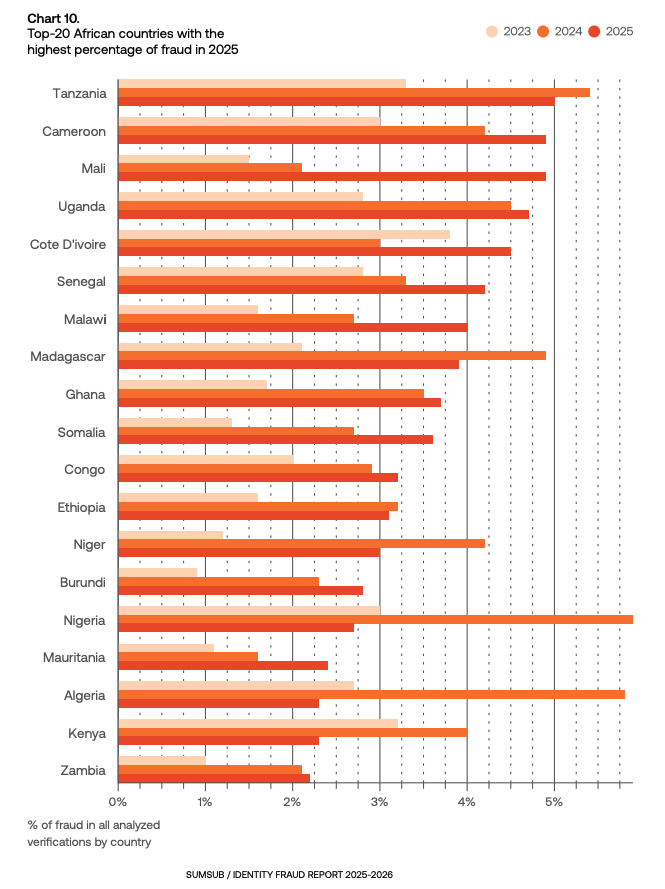
According to Sumsub’s deeper metrics, sadly, Nigeria remains the global capital for identity fabrication, generating 1 out of 10 of the world’s synthetic fakes.
But! No be only us day carry first. When we consider the progression of this mess year-over-year (YoY)it exposes the true velocity of the problem. While baseline fraud volumes might suggest stability in certain regions, the adoption of generative AI tools is exploding vertically. As illustrated, Zambia leads the entire continent with an astronomical 967% year-over-year surge in deepfake attempts.

Who it affects
Everyone is affected.
Our digital natives are usually pà pà pà, they are fast with everything. Everything is short, quick, and vibes. In a world wired for speed, almost nobody pauses to question, and everybody wants to be first to post, aura farm by all means. So speed becomes vulnerability, and with this, verification isn’t even an option.
The àgbàs (seniors) are often too unfamiliar to detect. Many have never even heard the word deepfake. In the iProov study, 39% of over-65s had never heard the term. They have no frame of reference. So when a grandchild calls, the thought that it could be fake does not even come to mind.
The rest of us (way we think say we wise) in the middle are slightly more aware, but affected all the same. (I place myself here, old enough to remember before, young enough to see where this is going.) Make I shock you, Remember that iProov study again, where only 2 out of 2,000 people passed the deepfake test, from that group 1,200 (60%) stayed confident in their ability to spot fakes, including the ones who got it wrong, so it’s not by confidence. I got 7 out of 10 correctly by the way. (if he sure for you oya, try your own test).
What else does it affect?
Our eyes and ears used to be enough. Not anymore. And the damage does not stop at the individual; it ripples outward through everything society is built on.
Trust and relationships
Society runs on trust, and AI has successfully hacked trust itself. Voice and face are the major identifiers we carry into the digital world, and today voice models can cheaply clone a person from as little as three seconds of audio, lifted from a voice note or a status update, at 80 to 90% similarity

A grandma sees her granddaughter’s face on a WhatsApp call and hears her voice, never imagining criminals scraping a public Instagram page to train the clone. We already have records of this in the FBI Criminal Report, 2025. And the FBI logged roughly $893 million in AI-scam losses the prior year.
He never finish o, some of these models are open-source (free to use and mostly without a trace), run on a regular computer without internet, no payment, no trace, nada (another story, another day).
Legal system
Justice is built on evidence, and evidence assumes an objective reality that can be captured, presented, and agreed upon, abi?. That foundation is cracking. In September 2025, a California court threw out an entire case after finding that the video testimony submitted was a deepfake. But the bigger trap here is something scholars call the liar’s dividend. Once anything can be fake, the guilty person can simply claim that the real evidence is a deepfake. Doubt becomes a shield. So now you carry a double burden: proving you have the evidence and proving the evidence is authentic.
Corporate world
Business runs on proof: receipts, approvals, video interviews, remote work. In our era of digital nomads, the entire backbone is video, audio, and tracking, and all of it can now be faked. Remember that Arup story in 2024?. The British engineering firm lost $25.6 million when an employee joined a video call with what looked and sounded like the CFO and colleagues, every one of them a deepfake, and this was 2 years ago! Biometric verification, voice ID, face ID, assumed your identity was uniquely yours. That assumption no longer holds water.
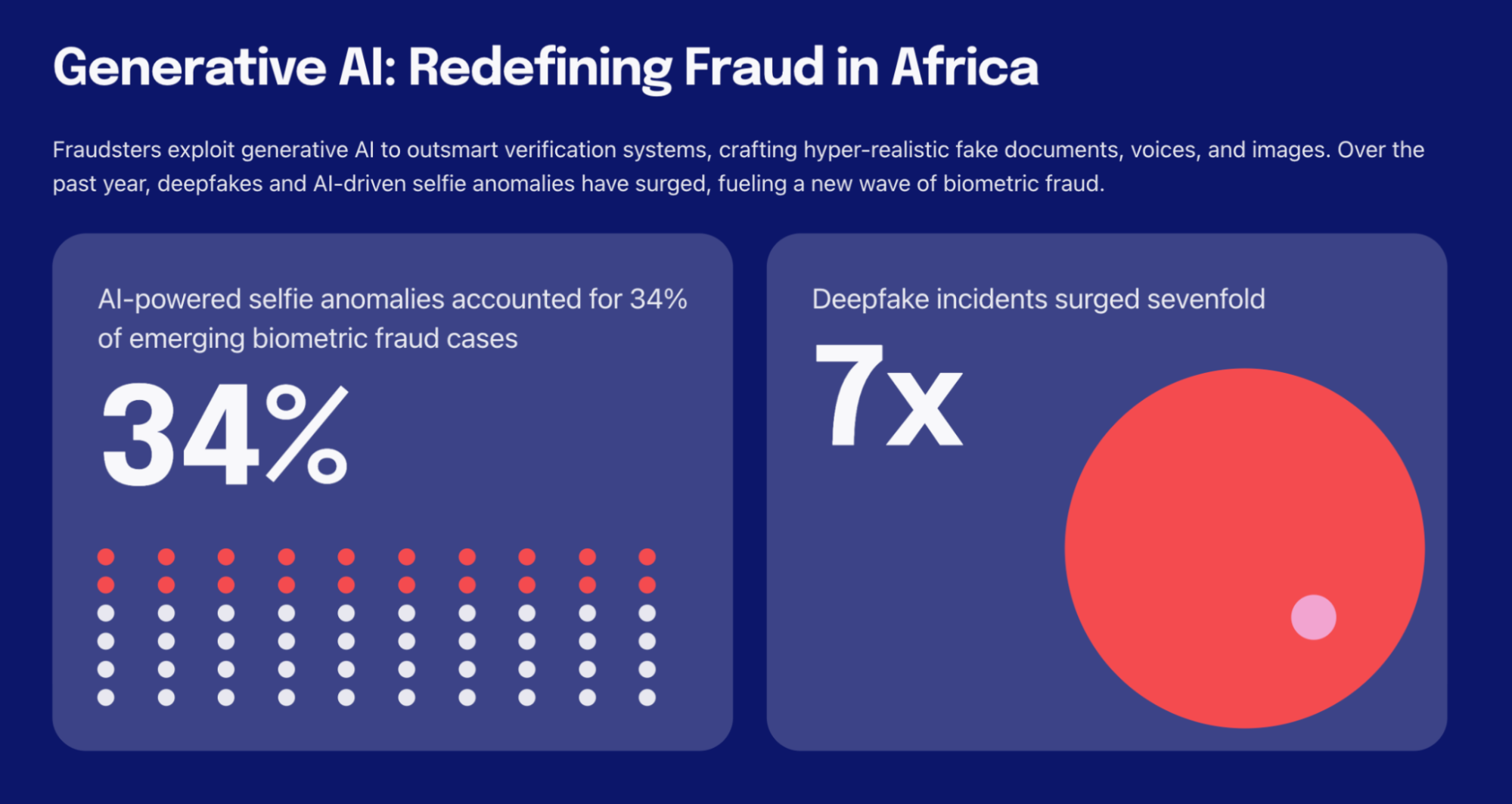
Back here in Africa, everyone is trying to cash out on remote jobs, and e-commerce is booming; the crisis is hitting hard: Smile ID’s Digital Identity Fraud in Africa Report reveals that deepfake incidents have surged sevenfold, with AI-driven selfie anomalies now making up 34% of all biometric fraud attempts on the continent.
By the end of this year, analysts at Gartner project that 30% of global enterprises will consider traditional identity verification completely unreliable in isolation. Apparently, when we opened virtual realities we also left the keys under the mat for bad (belle) people, tor.
Political system
Politics run on the same currency as everything else on this list: trust, and that currency is being counterfeited at scale. The Reuters Institute found 58% of people globally worry about telling fact from fiction online, and that concern is highest in Africa, at 73%. Hmmm!
Research from the Policy Center for the New South reveals that the primary threat is domestic; local political elites are increasingly deploying autonomous LLM-driven bot networks to contextually manufacture an illusion of consensus, until real voters go quiet in a spiral of silence, as they call it. Basically, you start to doubt your own opinion because everybody online seems to think differently, meanwhile everybody was never real.
In other words, gone are the days when vote-buying and rigging were the worst wahala democracy had to deal with.
An investigative report by Forus International details how this synthetic subversion is operationalized across our own soil. Beyond the seemingly harmless stuff, like the viral deepfake of President Tinubu that had people laughing and forwarding without a second thought, the technology has been weaponized with real, bloody consequences. In June 2025, a hyper-realistic deepfake news broadcast falsely claimed the Nigerian military was guarding cattle in Yelwata, Benue State. Released days after a real-world massacre that killed over 100 people, it was engineered to pour petrol on farmer-herder tensions that were already at boiling point. Similarly, coordinated campaigns in Kenya deployed deepfakes and forged technical notes falsely attributed to the International Foundation for Electoral Systems (IFES) to fracture voting coalitions.
Watch the pattern. These are not “what if” scenarios I am painting for effect. These are things that have already happened, and they move through encrypted apps like WhatsApp faster than any fact-checker can run. By the time the truth catches up, everywhere don scatter!
Verification turned upside down
The cruel twist is that we have always had ways to verify, in banking, in business, in family. The instinct was simple: doubt first, then confirm by checking a face, a voice, or a document.
AI has flipped this. The very signals we used to verify with- the face on the call, the voice on the phone, the document in your inbox- are now exactly the things being faked. You still need to verify, no question about that however, the old signals have been compromised. The ground you stood on has moved.
And this is not some pre-recorded clip you can study at your leisure anymore. O koja bee! (there’s more to it) It happens live! The same AI powering a customer-service agent that listens, pauses, and responds naturally (like ElevenLabs Agents) can just as easily be pointed at you. The conversation itself can be fake while it is happening, not after.
Big tech and the illusion of verification
So why should ordinary people carry the weight of closing this gap alone? Why us and not Big Tech?
Well, Big Tech is at least aware, and they are building things. But we have to ask, to what end?
Google has Synth ID; an example is the small, almost invisible star you see at the corner of that image wey Gemini dey generate for you. It was built allegedly to survive even a screenshot, and it is already stamped across over 100 billion images. There is also the C2PA Content Credentials, a broader standard of cryptographically signed metadata that records who made a file and how, now adopted by OpenAI among others. They are all useful, but we need to be honest about where it stops working.
How many of these watermarks survive a simple crop or re-upload, when entire platforms exist for the sole purpose of stripping them off? How many of these systems even speak an African language, when coverage barely stretches past English? How many ordinary people will ever think to pull up a file’s C2PA metadata, when most have never even heard the term? And how many grandmas, receiving a video call from her ‘granddaughter’, are going to pause mid-call and go ask Gemini, “is this AI-generated?” We all know the answers to these questions. The tools may actually exist, but the responsibility to reach for them is in the hands of the person least equipped to use them, when they need protection most.

You can now see how bad this is, right? Well, it gets worse.
OpenAI made an early attempt at a tool to detect AI-generated text, but according to them, it died on arrival! Gbam! Think about that: if the company that built the model cannot reliably detect its own output, wetin the rest of us fit do? (we’re cooked)
Meanwhile, platforms like YouTube now require creators to self-label AI-generated content, but the checkbox is still voluntary, so a bad actor simply does not check it. And when these platforms decide to detect and label AI content themselves, authentic creators dey collect stray bullet. They write and edit their own work, and get flagged and accused of using AI they never even touched.
Source: Youtube
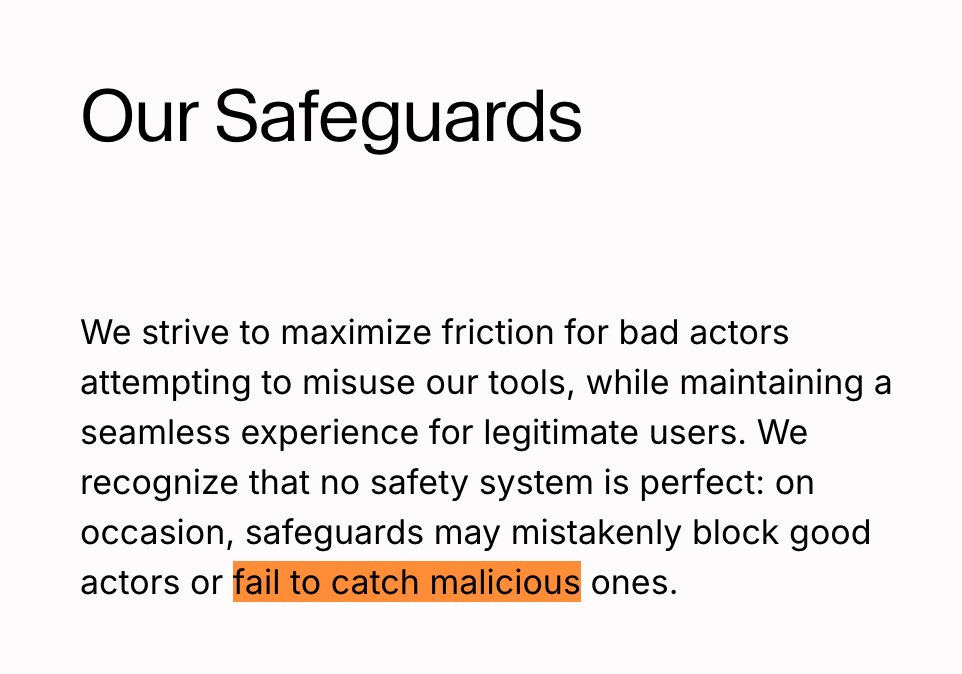
Even responsible players like ElevenLabs, who build in consent rules and block celebrity cloning, admit their own safeguards can be gamed.
When people stop trying
There is a subtle surrender happening beneath all of this. When people try to verify, fail, try again, fail again, many eventually just stop trying and accept whatever they are handed. Scott Alexander called this epistemic learned helplessness; not knowing what to trust, so trusting nothing, or worse, trusting whoever shouts the loudest. This is the democratisation of deception at its natural endpoint, and we cannot afford to run our society on that.
The second response is the one I am inviting you into. We build new habits. Because the answer is not despair.
What we can actually do
For you, today:
- Always assume it is not real, by default. Whoever calls, from last born to grandma, husband to side chick, sibling to bestie, or mentor to business partner (in short, anyone/anything that reaches out to you) if there is a request attached, start from the possibility that it might not be them.
- Agree on a private code word (or something exclusive or mutually understood) with your closest family. No code word, no money transfer. No exceptions. Ask a question only they could answer: your last meal together, your last conversation, a shared memory. Do not ask what a scammer could scrape.
- Chill, slow down. Urgency is the scammer’s weapon. Would your uncle really call at 5am? Would your pastor really demand cash on a Sunday afternoon? Check whether the request even fits the person.
- Call back on a number you already have, never the one that just messaged you.
- Look for the glitches: odd blinking, skin too smooth, lip-sync drift, audio that sounds slightly robotic or out of step with the video. These will improve over time, but for now, they still give you an edge.
- Search before you share. If someone claims an accident or a public event happened, verify before you commit or spread it.
- Talk to the vulnerable around you: with your mum, your grandpa, your niece- one conversation could make all the difference. Be the voice of advocacy.
Here’s a video that explains how to detect deepfakes:
For Communities
Oya, come closer – corporations, schools, religious bodies, market associations: run local digital-literacy drives in languages people actually speak, not just oyinbo (low key, this is one of the places Kini AI comes in by the way). Let people tell their stories. Big Tech will not do this for us o, so the work falls to us.
For Government
Una welldone o, legislation moving at the speed of the technology, public-awareness campaigns, and electoral safeguards that quickly become practice rather than just nice ideas on paper. Train and educate your people, starting with your staff then everybody else! It ṣe pàtàkì.
For Institutions
Legal, finance and security people, ejor: the old playbook no longer cuts it. We need new evidentiary standards, layered verification instead of trusting just one signal, and fraud-response systems built for a world where identities can be cloned.
For corporates
No dulling o. Put proper verification protocols in place, train your staff regularly, and make sure every money movement gets an out-of-band confirmation. That’s the Arup lesson; unfortunately, they had to learn it the expensive way.
Big Tech
Enle o! Abeg, no be every responsibility una fit outsource. Make provenance the default, build watermarking that withstands real-world contact, and ensure your safety systems understand African languages as quickly as bad actors do. We shouldn’t have to wait months for protection while the scams have already gone viral.
So what is real?
Apple once ran an advert that simply asked, what is a computer? It was their way of saying the old definition had broken down so completely that the question itself had changed.
I want to ask a similar question today. What is real?
Not as philosophy, but as a practical, everyday question. When a video can be fabricated. When a voice can be cloned from three seconds. When a news report can be machine-generated at scale. When the face on your screen may not belong to the person you think it does.
The answer is not despair. The answer is that we form new habits, new systems, and above all a new level of awareness. And it starts with the simplest possible step, knowing that the illusion exists.
Now you know.
Stay curious.