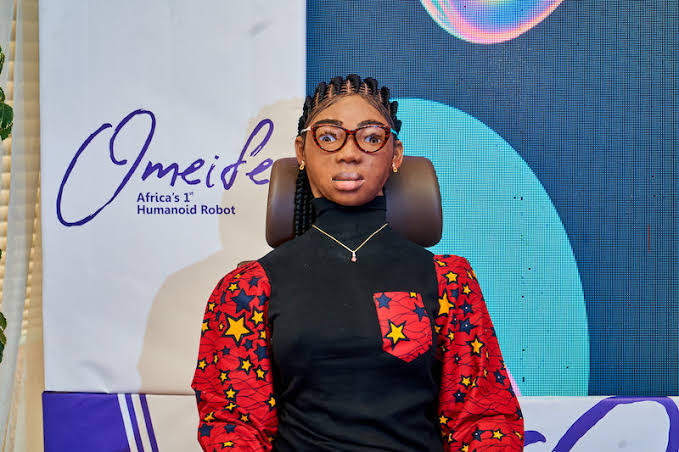

You may have seen Omeife before. Nigeria’s first humanoid robot, built in Abuja by the Uniccon Group under Professor Chuks Ekwueme, made waves when it was unveiled. A robot that speaks, understands African languages and cultural context, and was built entirely on the continent.
Now, Omeife’s AI brain has a new job. It is powering MySmartMedic; a Nigerian telemedicine platform that is bringing specialist-level healthcare to people who have never had access to it.

The announcement came this week, and it is significant not just as a tech story, but as a healthcare one.
Major Highlights
- Omeife, Africa’s first humanoid robot, built by Uniccon Group (Abuja) under the leadership of Prof. Chuks Ekwueme, has integrated its AI model into MySmartMedic — Nigeria’s telemedicine platform.

- MySmartMedic now offers AI-powered specialist diagnostics across Gynaecology, Cardiology, Paediatrics, Dermatology, and General Health, all accessible from a smartphone.
- The platform provides: virtual consultations, smart health assessments, e-prescriptions, remote monitoring, and secure digital health records in one place — no waiting rooms, no queues, no geographic restrictions.
- A key design decision: the AI does not replace doctors. It works alongside licensed Nigerian medical professionals, handling triage and early diagnosis support while physicians provide clinical judgment.
- Cultural intelligence is built in: Omeife was trained on African languages and behavioural patterns, meaning the AI on MySmartMedic understands African patients in ways that generic global health AI typically does not.
- The integration is particularly significant for women’s health — AI-assisted gynaecological evaluations and maternal monitoring without the cost, distance, and social stigma that keeps millions of African women away from specialist care.
- MySmartMedic is live now at mysmartmedic.com and available on Google Play and Apple iOS.
KINI BIG DEAL
Nigeria has a doctor-to-patient ratio of about 1 doctor for every 2,500 people. The WHO recommends 1 for every 1,000. The gap is not closing fast; training a doctor takes years, and many of the doctors Nigeria trains leave for better opportunities abroad. This is not a criticism. It is a structural reality that telemedicine, at its best, can help address.
What makes the Omeife-MySmartMedic integration interesting is the combination of two things that do not always go together: specialist-level capability and cultural fit. Generic health AI tools built in Silicon Valley or London may understand symptoms, but they have not been trained to understand how a patient in Kogi State describes pain, or the cultural factors that shape how a woman in rural Anambra talks about reproductive health. Omeife was built in Abuja, by Nigerians, for African contexts. That matters in healthcare more than in almost any other domain.
The hybrid model — AI for triage and early diagnosis, licensed doctors for clinical decisions — is also the right design. AI that replaces doctors entirely is not appropriate for high-stakes medical decisions yet, and probably not for a long time. But AI that helps a doctor see more patients, flag urgent cases faster, and give rural patients a first-line response before they make a long journey to a hospital? That is genuinely useful, right now, at scale.
E don happen. Nigeria built the robot. Now the robot is helping people see a specialist without leaving their village. That is the kind of story that tends to get missed in the global AI conversation, but it is the kind of progress that will matter most on this continent.