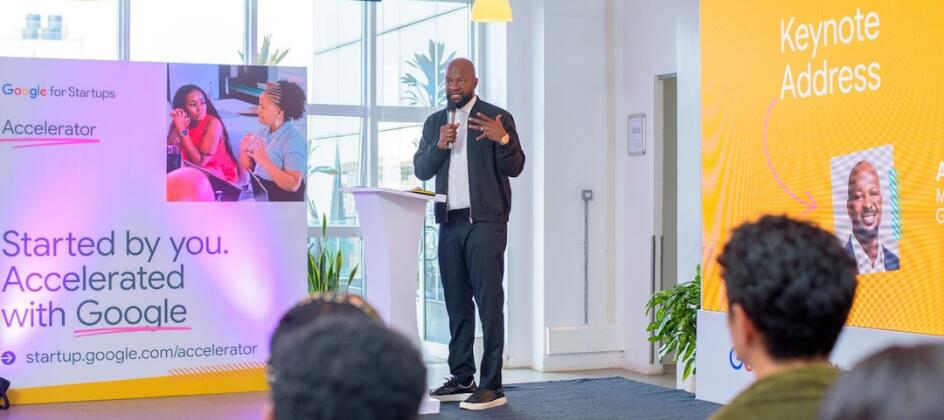

60% of the startups that just completed Google’s Africa AI accelerator are profitable. They are not just gaining momentum or promising. They are profitable, averaging a revenue of $60,000 monthly. These startups are building real products and serving real customers in eight African countries.
This is what AI adoption in Africa actually looks like as a present reality, rather than a future promise.
Google’s Africa MD, Alex Okosi, was at the graduation event in Nairobi, and even as he celebrated what the class had built, he said something valuable: investment in Africa has not kept pace with adoption. The founders are ready, but the ecosystem around them is not.

Major Highlights
- Google for Startups Accelerator Africa graduated 15 AI-first startups from 8 countries; Kenya, Nigeria, South Africa, Uganda, Tanzania, Senegal, Côte d’Ivoire, and Angola.
- 60% of the cohort is already profitable, with an average monthly revenue of $60,000; a significant number for early-stage African startups.
- Standout companies include include Mastery Hive (AI fraud detection across fragmented payment networks) and Loop (South Africa, AI for transit optimisation and worker payments in informal transport.)
- Google’s Africa MD Alex Okosi said plainly: investment from international capital has not kept pace with the AI adoption already happening across African markets.
- Africa currently accounts for just 1% of global data centre capacity, meaning most African AI startups process their data on servers outside the continent.
- The African Development Bank projects AI could add $1.5 trillion to Africa’s economy by 2035, roughly 40% of the continent’s current GDP.
- Since the accelerator launched, Google has trained 8 million Africans in digital skills, supported 35,000 SMEs, and backed more than 190 startups that have collectively raised over $300 million.
KINI BIG DEAL
When people talk about Africa and AI, the conversation often sounds like a question: Is Africa ready for this? What Google’s 2026 cohort answers, clearly, is: the founders are ready. They are building, shipping, and getting paid.
The real question is whether the rest of the ecosystem will catch up to them.
Africa at 1% of global data centre capacity is not a technology problem. It is an investment decision. Every African startup in that cohort is building on infrastructure owned by someone else, in a data centre on another continent, subject to pricing decisions and government directives that nobody on this continent controls. It has happened and it will keep happening as long as the only serious compute available to African builders is hosted abroad.
The Aeonian Project in Uganda is part of the answer. Google’s own planned South African cloud region is part of the answer, but they are still coming. In the meantime, the builders are here, the products are live, and the revenue is real. The only thing missing is the capital and infrastructure to match what the founders have already built.
If you are an investor wondering whether the African AI market is real, here is your data. Fifteen startups. Eight countries. Sixty percent profitable.
Read more: TechCabal — Google’s Alex Okosi on what’s holding back Africa’s AI startups